

Evening saunas and sleep: can warmth really help you fall asleep?
An evening sauna has a compelling rhythm: the day draws to a close, the light softens, your body warms up, and after a shower and some fresh air, you find yourself speaking more quietly. It is no wonder that many people associate this ritual with better sleep. But does warmth really help you fall asleep — and where does the evidence end and expectation begin?
The short answer is that passive heating before bed may help you fall asleep, but warm baths and showers have been studied much more thoroughly than saunas. We should therefore be cautious about applying findings from one form of heating to another. Instead, let us look at the underlying principle and how to create a safe evening ritual.
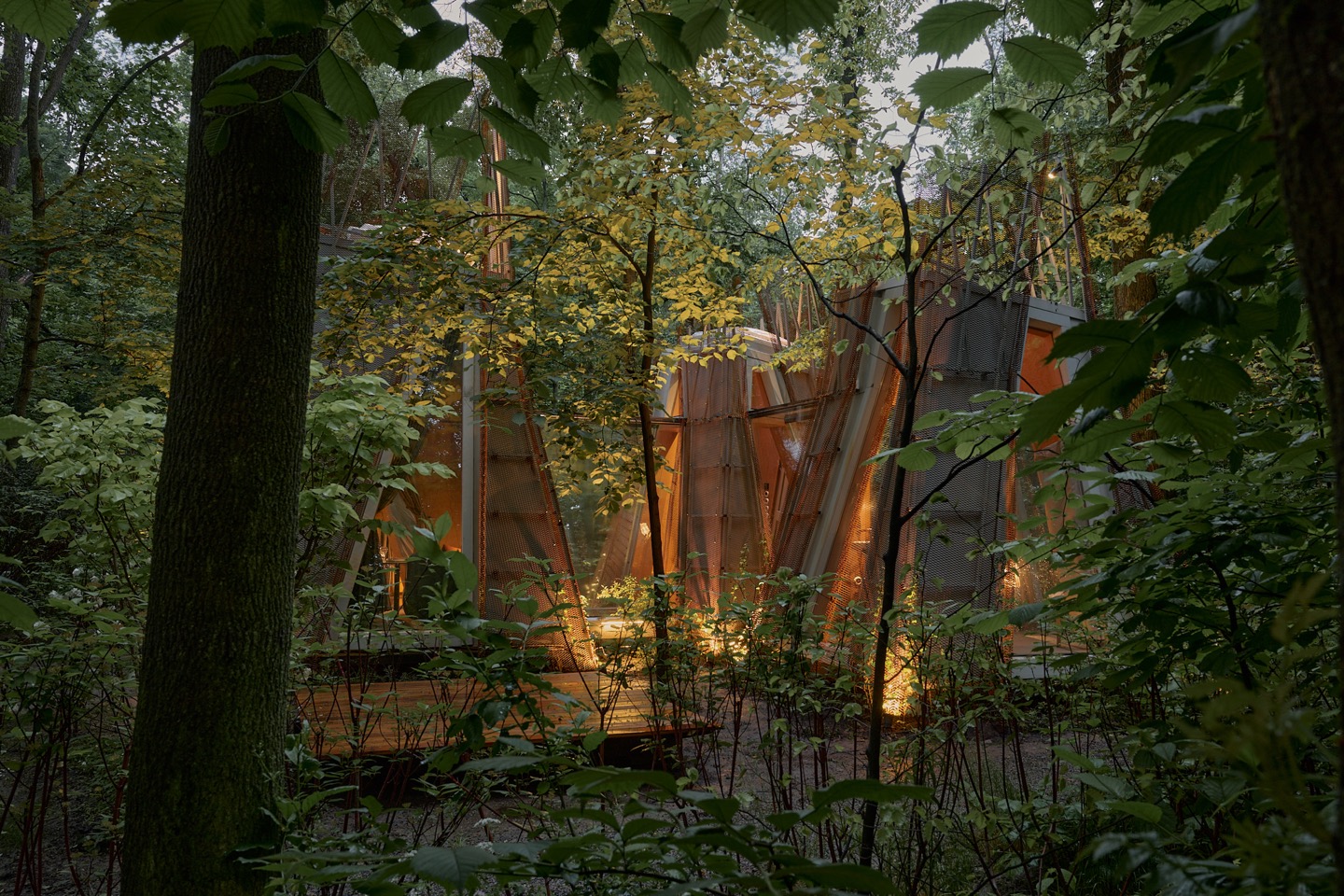
Sleep depends on cooling down as well as warming up
As the body prepares for sleep, its core temperature naturally falls. A warm bath or shower widens the blood vessels near the skin. After you get out, heat escapes more easily, and this cooling may reinforce the body’s natural evening signal.
A 2019 meta-analysis found that a warm bath or shower around one to two hours before bed may shorten the time it takes to fall asleep and improve subjective sleep quality. Precision matters here: these were mainly water-based treatments, not wood-fired saunas. A sauna also heats the body, but the intensity, humidity, sweating and physical demands differ. It is therefore more accurate to say that evening warmth may support relaxation, rather than guarantee sleep.
A ritual also works because it creates boundaries
Sleep depends on more than temperature. It benefits from repeated cues: dimmer lighting, fewer news updates, tasks brought to a close and a consistent waking time. An evening sauna creates a physical boundary between ‘I am still working’ and ‘the day is over’. When the phone is put aside and there is tea and quiet between sessions, the nervous system has fewer new demands to process.
This is not a treatment for insomnia. If sleep problems continue for weeks, or occur alongside snoring with pauses in breathing, severe daytime sleepiness, anxiety or symptoms of depression, speak to a doctor. Finding the cause matters more than an endless search for the ‘perfect’ wellness treatment.
What this research cannot tell us about saunas
In the 2019 meta-analysis, only 17 studies met the review criteria, and 13 provided comparable data for quantitative analysis. The authors themselves stressed that the number of studies was limited and that the best timing, duration and precise mechanism still needed clarification. Most relevant here is that the studies examined warm baths, showers or foot baths, not an evening in a wood-fired sauna.
You should therefore not take a water temperature from the research and turn it into the ‘correct sauna temperature’. Nor can anyone promise that one session will shorten the time it takes to fall asleep by a particular number of minutes. A sensible approach is to treat the sauna as a personal way to end the day, notice your own response and avoid using it as a substitute for help with persistent sleep problems.
An evening ritual at NAMETY
- Do not arrive hungry or just after a heavy dinner. Either extreme can make you uncomfortable. A light meal some time beforehand is a simpler option.
- Start with water. A glass of water before your first session matters more than a ‘special detox tea’.
- Choose moderate heat. There is no reason to make your evening visit the longest, hottest sauna session of the year. Overheating, a racing heart or a headache certainly will not help you fall asleep.
- Finish gently. Fresh air and a comfortable shower, if one is available with your booking, give you time to ease out of the heat. An ice-cold plunge can feel very invigorating, so it is not for everyone before bed.
- Allow some extra time. Do not plan to jump straight from the sauna into bed. Leave time for water, a quiet conversation, a shower and gradual cooling; there is still no universally established interval specifically for saunas.
What can undermine the effect
Alcohol. Do not combine it with a sauna. Water and alcohol-free tea are safer, more predictable choices for an evening ritual.
Too much contrast. If ice-cold water gives you a burst of energy, that is a good reason to try it earlier in the day.
Returning to screens. An hour of quiet loses some of its value if you follow it with forty minutes of work messages in bed.
Finishing too late. Even a pleasant ritual can push back bedtime. If you need to get up in the morning, it is better to start earlier than to cut your night short.
Warmth does not calm everyone in the same way
Some people feel relaxed after a sauna; others still have a faster pulse and intense thirst an hour later. Your response depends on the temperature, duration, fitness, familiarity with the sauna, time of day and even how much water you have drunk during the day. It is better to make your first evening visit a gentle experiment than a dress rehearsal for ‘perfect sleep’.
If you keep a sleep diary, consider not only how quickly you fall asleep but also awakenings, how you feel in the morning and the total length of your night. One good or bad evening proves nothing. A recurring pattern matters more.
Five simple things to do when you return to your cabin
- air the room and keep it comfortably cool;
- drink some water, but do not try to make up for everything with a litre just before bed;
- dim the overhead lighting;
- leave work chats until the morning;
- go to bed at roughly your usual time.
A ritual works better when it is simple and repeatable. If falling asleep requires ever higher temperatures, longer sessions or more extreme contrasts, it has become another results-driven project rather than a way to slow down.
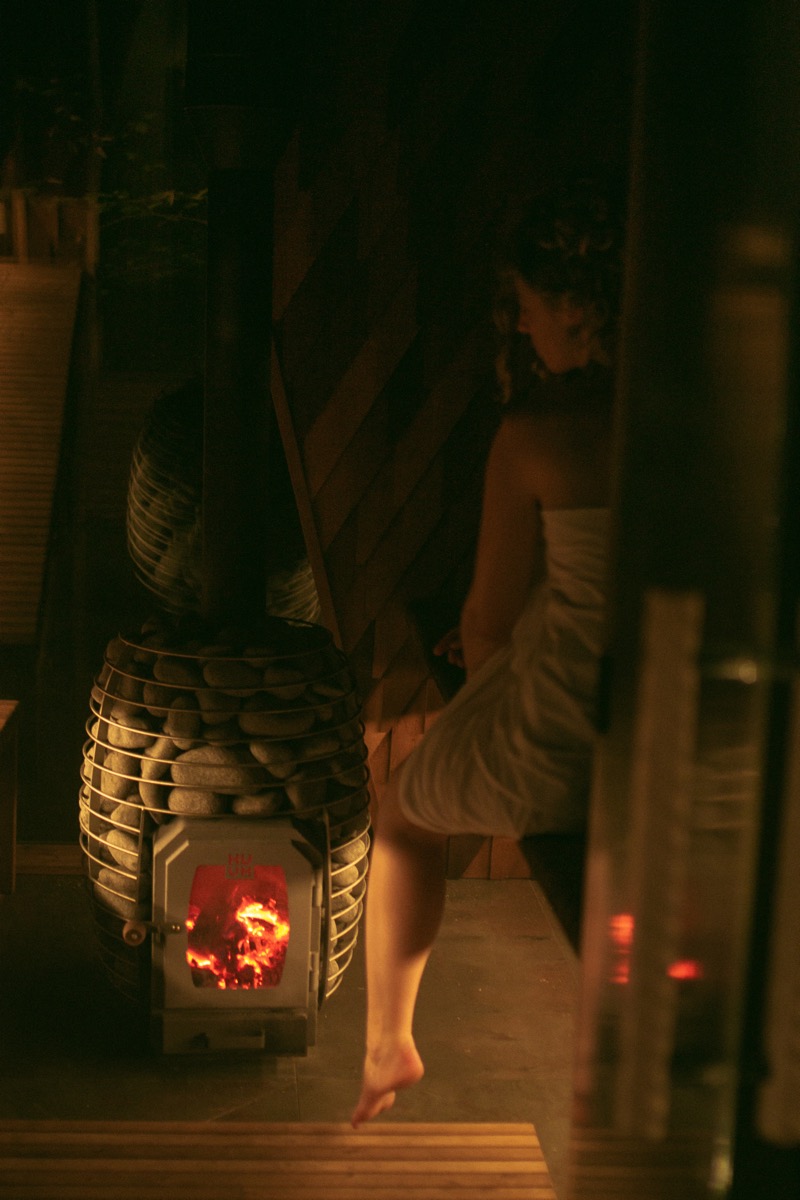
A sauna and a cabin: no need to switch back to city life
The gentlest evening option is to combine a sauna with a stay at NAMETY. Afterwards, there is no need to drive across Kyiv, look for parking or switch back to navigation. You can return to your cabin, take a shower, dim the lights and let the forest outside your window be the last view of the day.
Think of a sauna as a way to create conditions in which sleep can come more easily, rather than as a sleeping pill. Sometimes that is enough; sometimes the cause of insomnia lies somewhere else entirely.
Book a sauna for two, explore other NAMETY saunas or choose a cabin for a night in the forest.
Read also: an idea for a phone-free date and what heat actually does to the body.


